
Frequently Asked Questions
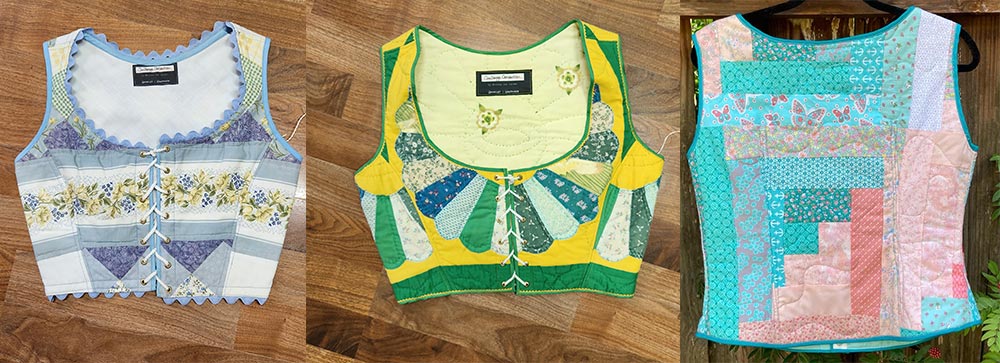
This is the question I most frequently hear when I do a popup shop or art fair. And the answer is yes, I do in fact make all this stuff. I even make my own tags.
Like many other creative people, I collect skills as if they were books in a library. When I see an interesting technique, or when I find a new tool at a thrift shop, I have to get in the studio and try it out. When the creative spark strikes, I can dip into my library of skills and create the thing I envisioned.
I do not use generative AI. Full stop.
I do not use sewing patterns that are generated using AI.
I do not use fabrics that were created with AI.
I do not use AI to help me write copy for my listings.
We do not use AI to assist with website work.
All of our photographs are captured in real time, from real life.
There is an abundance of cheap AI-generated patterns online, easily searchable and available for instant download for at-home printing. Despite having such an unlimited library of sewing patterns available at a click, I choose to self-draft every pattern in my collection. Pattern drafting requires a complex set of skills and years of experience working fabric. Taking an idea from the pattern stage to the ready-to-sell stage means that piece has to be made at full scale, using similar materials to the final product. The first prototype is evaluated, changes and adjustments are made, and another prototype is worked up. This process continues until I have the garment or accessory looking, fitting, and functioning just the way I want it.
Since the vast majority of materials that I use are secondhand, vintage, or otherwise “not new,” it is relatively easy to avoid AI in my fabric choices. I will admit that I am sometimes tempted by the beautiful modern prints advertised on sites like Spoonflower and Fabric on Demand, but neither site guarantees that the designs they offer are human-made. The last place that I want to see AI is in creative fields, like textile design. Let’s leave the art to the humans and let the computers stick to coding.
Writing copy for website listings is not fun, unless you work for the J. Peterman company. I personally write each and every one of the clunky, ineloquent descriptions for all my items. It pains me to do so, as my strengths lie in making this stuff, not discussing it, but I push through anyway. I try to think about how I would describe each piece if you walked into my boutique and asked me to tell you more about it. Sort of conversational, but a little more formatted. I usually think my descriptions sound stitlted and ridiculous, so just look at the pictures and maybe don’t even bother reading them, okay?
My team is just me and my partner, Justin. I make the stuff, take the photos, write the copy, and generally direct the ship. Justin handles all the website related stuff. He has learned website building and maintenance step by step, figuring things out as we go along. We acknowledge that AI is embedded in the programs that drive web building software like Word Press, but we do not directly employ generative AI to handle any aspects of website maintenance.
The photographs on this website are all taken from real life, and are unaltered except for color correction. I do not use AI filters to clean up the images, remove the background, or stage a scene with the item in it. I admit that AI is also embedded in color correcting software, but this type of AI has been around for decades, and is not fraught with the same problems that generative AI is. The editorial style photographs were taken by my sister, Rachel Weaver, a professional photographer in the DC/Maryland/Virginia area; and by Justin, a professional photographer in his own right. The product photography is done by me (and I enjoy doing product photos about as much as I enjoy writing copy…).
I will be the first to say that as a micro-business, AI could help me do many things. It might increase my efficiency. It might take off my plate some tasks that I don’t enjoy doing. Nevertheless, I will remain admantly commited to avoiding the use of generative AI. Despite its appeal, the societal, environmental, and humanitarian impact is not worth the cost. Call me a luddite. I’m okay with that.
Generally, I am able to ship ready-to-wear items the day after you order. Rush shipping is available, if needed, at additional cost. I ship via USPS, UPS, and FedEx. If you have a preferred carrier, please note that when placing your order, and I will do my best to accomodate your request.
The turn-around time for custom work and/or alterations will vary. Contact me to find out what my current bench schedule looks like. If you are under a time constraint (birthday, holiday, upcoming event), please note that when you reach out.
Yes! Many of my designs have options for customization, like adding or changing pockets, modifying the front closure, or adding elastic to cuffs. For more creative customization, please contact me. Consider adding a patch(es), or a personalized insert, decorative trim(s), embroidery or top-stitching… If you can describe it, I can sew it.
Yes! Have you found something in my collection that you just adore, but it is not the size you want? Please inquire about having the garment altered to fit. I will walk you through how to measure yourself or your existing clothing so the changes you want are clearly communicated before I begin resizing your purchase.
If you have already received the item and would like it altered, I am happy to have you return it to me for tailoring, although it may be more cost effective to find someone local to you and save the expense of shipping.
Custom orders are not returnable or eligible for exchange. Ready-to-wear items that have been customized or altered are not eligible for return or exchange. Canned goods are not eligible for return or exchange.
I accept returns on other merchandise within 30 days of the date of delivery, and exchanges within 60 days.* If you need to return or exchange your purchase, you are responsible for the cost of shipping. For returns, the original cost of shipping will be deducted from your refund total. For example, if you purchased a garment that qualified for free shipping, and then need to return it, your refund amount will be the purchase price minus the amount I spent to send the package to you. For exchanges, you must pay to send the item back, and to have the new item sent. You will receive a separate invoice for return shipping that must be paid before your exchange item will be mailed.
Shipping has become very expensive. I regret that this policy is necessary, but I am an independent artist trying to earn a living from my work, not some big corporation that can afford to absorb the costs of casual buy-and-return shopping. I am happy to answer all your questions about an item and provide additional measurements, photos, or any other information you may want before making a purchase so that you are confident that you will love it when it arrives.
In order to avoid needing to return a garment for fit issues, I recommend you compare the garment you want to a similarly shaped garment in your existing wardrobe. Lay your garment flat and measure it, then compare those measuremets to the measurements of the garment you are considering for purchase. If your garment fits you well, and its measrements are the same as the garment I made, then it is reasonable to expect a good fit.
*Items are shipped with a 360ID tag that prevents wear-and-return scams. Once you remove the 360ID tag, the item is not eligible for return or exchange, regardless of whether it is within the allowed timeframe. The 360ID tag does not interfere with your ability to try garments on.
Any non-canned goods purchase over $100 qualifies for free standard shipping. Orders under $100 that do not include canned goods ship for a flat rate of $10. Canned goods purchases are charged actual shipping costs with no additional markup (please contact me to calculate your exact shipping cost for canned goods orders).
Ready-to-wear orders typically ship out within one business day. I will notify you via email if there is any reason I am unable to send your order promptly.
All orders are shipped with insurance. Depending on the carrier, you may be required to sign for the delivery.
In the event of a lost or damaged package, your assistance may be needed to process a claim. If the carrier requires action from the receiver (you) in order to complete the claims process, you must do so in a timely manner, as dictated by the carrier’s policy. Usually, when a package is lost, they only need to hear from the sender (me), but there are some instances where you could be asked to provide additional information, or to file a police report (for claims of “porch pirate” theft).
There is no exact answer to this question! There are a number of factors that determine if a textile is large enough to make the garment you want from it. Let’s consider a quilt jacket, for example.
First, the specific style of jacket will dictate how large the quilt needs to be. The Arlo hoodie is made from large cuts, which means a large quilt is needed to get clean cuts, while the Dylan trucker jacket is made from smaller pieces that can be snuggled in tight on a smaller quilt. If it is necessary for me to piece together large cuts on a smaller quilt, that adds to the working time, but is an option to consider, if necessary.
Secondly, the pattern of the quilt impacts how I can lay out the cutting pieces. If the quilt has a center medallion design (i.e.: Lone Star), it looks best when the front and back panels of the jacket are oriented along the center axes. For quilts that have defined borders or a decorative edging, I would shift the cutting pieces to the edges of the quilt to incorporate those features. Sometimes, fabrics have a noticeable “right side up,” (i.e.: Baltimore Album) which means I will need to orient all the pieces so they are in an upright position in the finished garment. These are only a few of the criteria I evaluate when considering how to cut out a garment from a quilt.
Third, there may be areas of the quilt that are damaged, stained, faded or worn. We may opt to make repairs to these areas if it is feasible, or I may need to avoid them. If the textile you wish to use is extensively damaged, please contact me to discuss our options.
Lastly, when a quilt is just flat-out too small to make what you want from it, I am able to fabricate matching inserts to extend the amount of material we are working with. I find fabrics that coordinate with your original textile and sew panels to make up for whatever yardage we are short. This is a premium service, and is billed at a rate of $100 per square yard, rounded up to the nearest quarter yard. As a rough example, if you wanted an extra large Arlo hoodie made from a throw quilt, I would estimate we need an extra half yard of insert panel(s). But again, every project is unique, so lay out the textile you want to use, snap some photos, and send them to me! Consultations are free. Let’s discuss.
Send me a message
If you can’t find what you’re looking for in our FAQ or have a question about a potential project, please send me a message and I’ll get back in touch as soon as I can.